
Battery Storage for a Poultry Farm: When It Pays and How to Size It
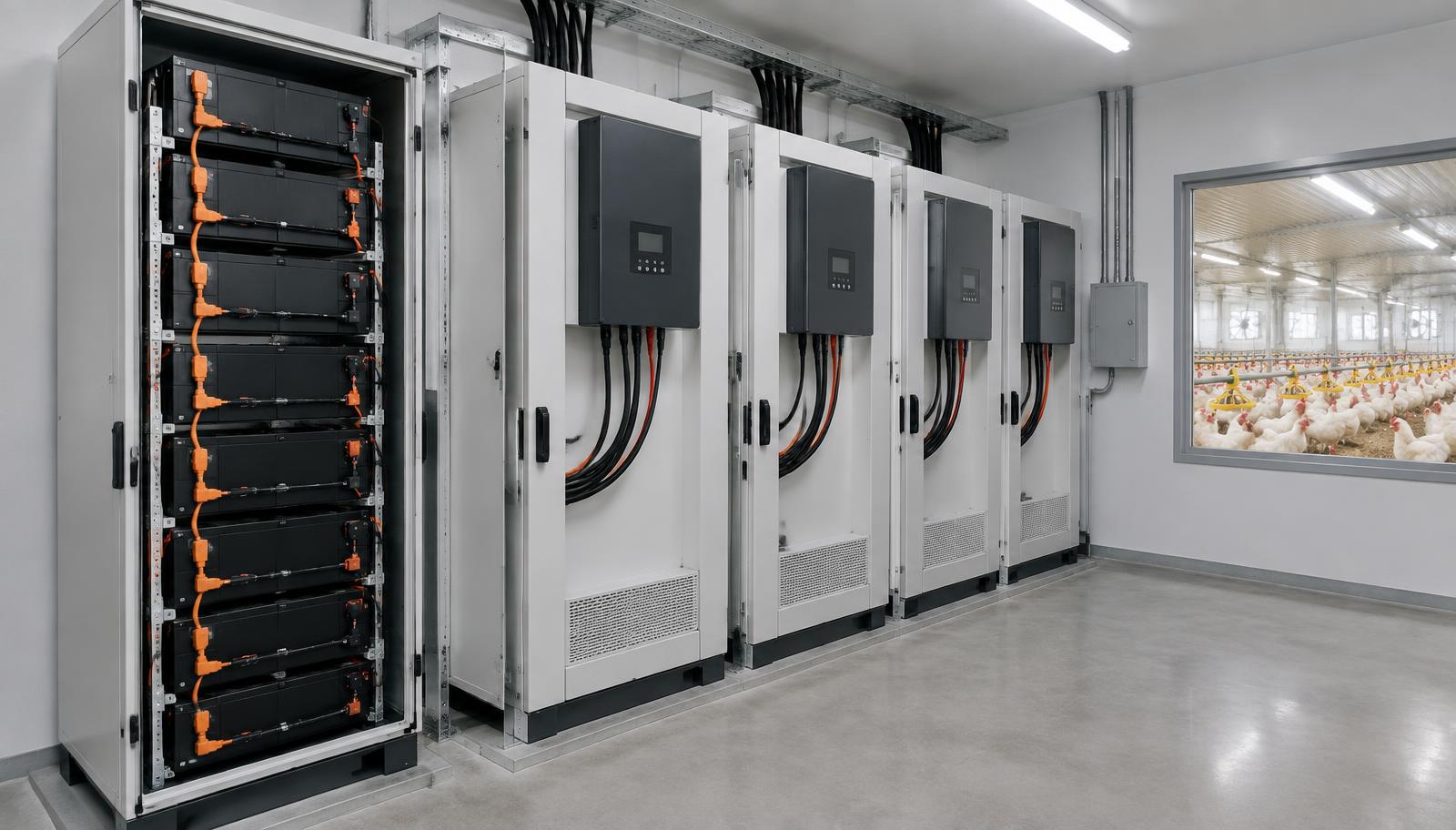
Battery storage on a poultry farm is not a substitute for a generator — it is a different tool. Here is how to know which one you actually need, and how to size a BESS if the answer is 'both'.
By HatchMatch Group Editorial Desk
In short
Short answer. Battery storage on a poultry farm does one of three distinct jobs: bridging critical load for seconds to minutes until a generator starts (small, high-power BESS), shifting solar power into evening hours (medium BESS), or full off-grid autonomy (very large BESS, rarely the most economic choice). Each job has a different kWh size, chemistry and cost.
Key takeaways
- For a broiler complex with 400 kW of critical load and a 15-second genset start, the raw energy is 1.
- For a 150,000-bird layer farm with 300 kW of night lighting and egg-belt load running 6 hours, shift-storage is 300 × 6 = 1,800 kWh of usable capacity.
- Full-week autonomy on a 100,000-bird broiler farm during peak growout can require 15,000–25,000 kWh of usable BESS at CAPEX above USD 5M.
- For poultry farm sites, LFP is the default.
- BESS enclosures in poultry-farm applications must be sited outside bird-occupied buildings — code requirement in most jurisdictions and simple risk hygiene everywhere else.
Short answer. Battery storage on a poultry farm does one of three distinct jobs: bridging critical load for seconds to minutes until a generator starts (small, high-power BESS), shifting solar power into evening hours (medium BESS), or full off-grid autonomy (very large BESS, rarely the most economic choice). Each job has a different kWh size, chemistry and cost. For most sites, a small LFP battery paired with a diesel genset — not a giant standalone BESS — gives the best return. Size against usable kWh at 80–90% depth of discharge, not nameplate capacity, and keep the enclosure outside bird-occupied buildings.
Lithium battery energy storage systems (BESS) have dropped in price fast enough that they now show up in almost every poultry-farm energy conversation. The question is no longer 'should I have batteries' — it is 'what job are the batteries actually doing'.
Three Distinct Jobs Batteries Can Do
1. Bridge to genset start (30 seconds to 15 minutes of critical load). Small BESS, high power, low energy. Solves the setter-reset and fan-restart problem.
2. Shift solar to evening hours (2–6 hours of essential load). Medium BESS. Increases self-consumption of PV where net metering is unfavourable.
Want these figures for your own site, capacity and country? A HatchMatch specialist builds the budget with you — no buyer fees.
Start free3. Full off-grid autonomy (12–48 hours). Very large BESS. Only economic where grid extension is prohibitive.
The specification, kWh sizing and cost of these three jobs are wildly different. Confusing them is the most common mistake in solar-plus-battery poultry projects.
Sizing for Bridge-to-Genset
For a broiler complex with 400 kW of critical load and a 15-second genset start, the raw energy is 1.7 kWh — but the practical BESS is 25–50 kWh to keep discharge C-rate reasonable and reserve depth-of-discharge margin. Cost: USD 12,000–25,000 for a poultry-farm-grade lithium iron phosphate (LFP) unit with inverter.
Sizing for Solar Shifting
For a 150,000-bird layer farm with 300 kW of night lighting and egg-belt load running 6 hours, shift-storage is 300 × 6 = 1,800 kWh of usable capacity. At USD 350–500/kWh installed (LFP + PCS + BOS) that is USD 630,000–900,000. Payback depends heavily on the delta between daytime and night tariffs — typically 6–12 years.
Sizing for Off-Grid
Full-week autonomy on a 100,000-bird broiler farm during peak growout can require 15,000–25,000 kWh of usable BESS at CAPEX above USD 5M. Rarely optimal — a smaller BESS + PV + genset hybrid almost always wins.
Chemistry
For poultry farm sites, LFP is the default. Higher cycle life (6,000+ cycles at 80% DoD), better thermal stability in hot barns, no cobalt supply-chain exposure. NMC has higher energy density but is not worth the fire-load risk near birds.
DoD and Cycle Life
Specify usable kWh, not nameplate kWh. LFP is typically rated to 80–90% DoD; do not size against 100%. Expect capacity fade of 2–3% per year in typical poultry-farm ambient conditions.
Fire, Ventilation and Siting
BESS enclosures in poultry-farm applications must be sited outside bird-occupied buildings — code requirement in most jurisdictions and simple risk hygiene everywhere else. Specify UL 9540A test data, containerized or NEMA-rated cabinets, dedicated FM-200 or aerosol suppression, and 3 m clear zone around the enclosure.
Warranty
Ten-year warranty at 70% end-of-warranty capacity is now standard for tier-1 LFP. Anything shorter, or defined only in cycles rather than years, is a red flag.
Next Step
Confirm which of the three jobs your project actually needs, then use the HatchMatch generator + battery sizing calculators together — a small BESS in front of a diesel is often the highest-ROI configuration on a modern poultry farm.
FAQ
Is battery storage a replacement for a diesel generator on a poultry farm? No. A small, high-power BESS is normally used to bridge the 30 seconds to 15 minutes it takes a generator to start, not to replace it for extended outages.
How much usable battery capacity does a layer farm need to shift solar power to the evening? For a 150,000-bird layer farm with 300 kW of night lighting and egg-belt load running 6 hours, usable shift-storage is roughly 1,800 kWh (300 kW × 6 hours).
What battery chemistry is recommended for poultry-farm sites? Lithium iron phosphate (LFP) is the default, for its higher cycle life (6,000+ cycles at 80% DoD), better thermal stability in hot barns, and no cobalt supply-chain exposure.
What warranty should a poultry-farm BESS carry? A ten-year warranty at 70% end-of-warranty capacity is now standard for tier-1 LFP; anything shorter, or defined only in cycles rather than years, is a red flag.
Frequently asked questions
- Is battery storage a replacement for a diesel generator on a poultry farm?
- No. A small, high-power BESS is normally used to bridge the 30 seconds to 15 minutes it takes a generator to start, not to replace it for extended outages.
- How much usable battery capacity does a layer farm need to shift solar power to the evening?
- For a 150,000-bird layer farm with 300 kW of night lighting and egg-belt load running 6 hours, usable shift-storage is roughly 1,800 kWh (300 kW × 6 hours).
- What battery chemistry is recommended for poultry-farm sites?
- Lithium iron phosphate (LFP) is the default, for its higher cycle life (6,000+ cycles at 80% DoD), better thermal stability in hot barns, and no cobalt supply-chain exposure.
- What warranty should a poultry-farm BESS carry?
- A ten-year warranty at 70% end-of-warranty capacity is now standard for tier-1 LFP; anything shorter, or defined only in cycles rather than years, is a red flag.
More buyer questions are answered in our poultry procurement FAQ — also available in Español, Français, Português, Deutsch, العربية, Русский, Türkçe, Tiếng Việt.
From this article to a procurement-ready RFQ
HatchMatch Group is an independent sourcing desk — not a manufacturer or EPC contractor. These are the four steps we actually use with commercial poultry and hatchery buyers. If you are still deciding scope, start with what commercial poultry equipment includes and how suppliers are compared.
- 1. Plan the projectCapacity, climate and house layout in one guided workflowOpen
- 2. Build the RFQScope, specifications and comparable line itemsOpen
- 3. Submit the requestReviewed manually before HatchMatch contacts any supplier on the buyer's behalfOpen
- 4. Track and compareFollow status and normalise supplier responsesOpen
Prefer the numbers first? Start with the poultry project cost calculator or browse the project planning guides.