
Backup Generator for a Poultry Farm: Sizing, Load Profile & Fuel Autonomy
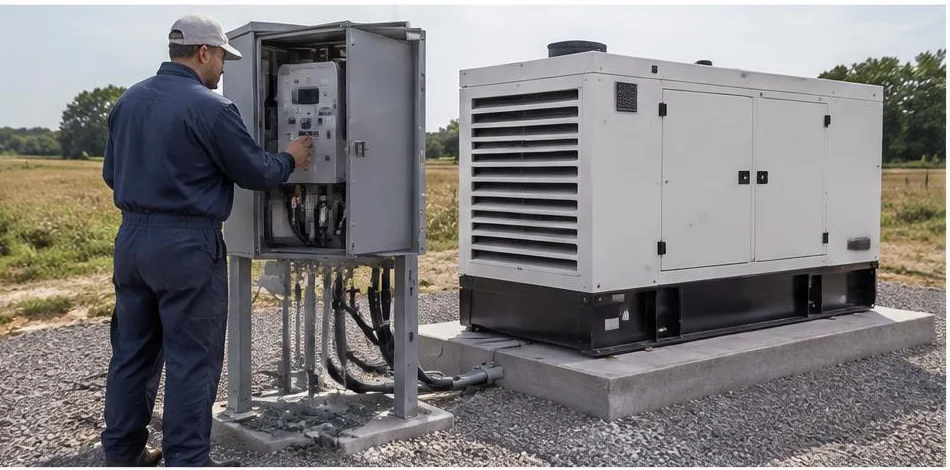
A rigorous walkthrough of how to size a backup generator for a modern poultry farm — from peak ventilation load to fuel autonomy, ATS and switchgear.
By HatchMatch Group Editorial Desk
In short
Short answer. Size a poultry farm backup generator from a load profile — not a nameplate total — that separates critical loads (tunnel fans, pad pumps, controllers, setters/hatchers) from essential and non-essential loads, adds 25% margin for motor-starting kVA, and uses prime (not standby) power rating for daily-outage duty. Fuel autonomy should match your actual outage duration (4–12 h vs 24–72 h), ATS ampacity should carry margin on the neutral, and a small UPS should sit ahead of hatchery incubator controls.
Key takeaways
- The wrong way to size a poultry farm generator is to add up every motor nameplate and buy a genset for that number.
- Tunnel fans are direct-on-line or VFD-driven induction motors with a starting current of 5–7× full-load amps.
- In regions where grid outages last 4–12 hours, a base fuel tank is adequate.
- The Automatic Transfer Switch (ATS) is what turns a generator into backup power.
- Installed cost depends on rating, fuel tank size, canopy, ATS, cabling, commissioning and local labour, so ask suppliers to quote the complete package rather than the genset alone.
Short answer. Size a poultry farm backup generator from a load profile — not a nameplate total — that separates critical loads (tunnel fans, pad pumps, controllers, setters/hatchers) from essential and non-essential loads, adds 25% margin for motor-starting kVA, and uses prime (not standby) power rating for daily-outage duty. Fuel autonomy should match your actual outage duration (4–12 h vs 24–72 h), ATS ampacity should carry margin on the neutral, and a small UPS should sit ahead of hatchery incubator controls.
A backup generator is not an accessory on a modern poultry farm — it is a life-safety asset. Once tunnel ventilation stops in hot weather, bird core temperature climbs within minutes, and a 20-minute outage during finishing can cause catastrophic mortality. Sizing the generator correctly, and pairing it with the right transfer and control gear, is one of the highest-leverage decisions in the electrical design.
Step 1 — Build the Load Profile, Not Just a Nameplate Total
The wrong way to size a poultry farm generator is to add up every motor nameplate and buy a genset for that number. The right way is to build a load profile that separates critical, essential and non-essential loads and identifies the worst-case simultaneous demand.
Critical loads (must run continuously): tunnel and minimum ventilation fans, evaporative pad pumps, controllers, drinker pressure regulators, brooder ignition, biosecurity lighting, and — in a hatchery — setters and hatchers.
Want these figures for your own site, capacity and country? A HatchMatch specialist builds the budget with you — no buyer fees.
Start freeEssential loads (must run daily but can be shed briefly): feed augers, silo fans, egg belts, wash-down pumps, office HVAC.
Non-essential loads: exterior lighting, workshops, staff amenities, EV charging.
The generator is sized around the critical + essential envelope during the worst hour of the worst month, not the sum of everything on the single-line diagram.
Step 2 — Motor Starting, Not Just Running kW
Tunnel fans are direct-on-line or VFD-driven induction motors with a starting current of 5–7× full-load amps. A 50 kW running load can transiently demand 90–110 kVA for a few seconds. Under-sizing here causes voltage dip, controller resets and staggered fan starts that defeat the ventilation strategy exactly when it matters.
Rules of thumb for poultry farm gensets: use prime power rating (not standby) for daily backup duty; provide 25% margin over calculated peak kVA; verify block-load acceptance for the largest single motor; and specify a genset alternator that tolerates ≥30% subtransient voltage dip.
Step 3 — Fuel Autonomy
In regions where grid outages last 4–12 hours, a base fuel tank is adequate. In regions where an outage can last 24–72 hours (or in remote sites with weekly refuelling), a day tank plus bulk tank arrangement is required. Design the tank around litres per kWh × expected running load × required autonomy, then add a safety factor for cold starts and low-load derating.
A rough number for a 500 kVA diesel prime genset at 70% load: 78 L/h. For 24 hours of continuous run that is 1,870 L of usable fuel, plus 10% reserve — a 2,100 L working tank at minimum.
Step 4 — ATS, Switchgear and UPS
The Automatic Transfer Switch (ATS) is what turns a generator into backup power. Specify ATS ampacity from three-phase peak kVA + 25% margin, rounded up to a standard frame (100, 160, 250, 400, 630, 800, 1250, 1600, 2000, 2500, 3200 A). Program a break-before-make transition of 6–10 seconds — long enough for the genset to reach nominal frequency, short enough to protect birds.
For hatcheries, add a UPS between the ATS and setter/hatcher panel. A 5-second gap during a transfer is enough to reset incubator PLCs and disturb temperature profiles — a small N+1 UPS bridges that gap.
Step 5 — Budgeting the Installation
Installed cost depends on rating, fuel tank size, canopy, ATS, cabling, commissioning and local labour, so ask suppliers to quote the complete package rather than the genset alone. Size the unit with the generator calculator and model the wider project budget in the farm cost calculator, whose backup power payback section checks whether the generator pays for itself.
Common Mistakes
Sizing on running kW without motor starting margin. Fans start staggered, but pad pumps and augers can coincide.
Sizing on standby rating for daily-outage sites. Standby-rated gensets are designed for <200 h/year at variable load — daily grid instability requires prime-rated units.
Skipping the ATS ampacity check on the neutral. Poultry farms are unbalanced loads; the neutral can carry 60–80% of a phase and must be sized accordingly.
Forgetting exhaust and ventilation on the genset room. A 500 kVA diesel rejects ~350 kW of heat — the genset room itself needs 25,000+ m³/h of airflow.
Next Step
Use the HatchMatch generator sizing calculator to convert your load list into a prime-rated genset kVA, fuel-tank litres, ATS ampacity and UPS kVA in one pass. Then request a quote through the backup power RFQ so suppliers researched on capability compete on a like-for-like specification.
FAQ
What size generator does a poultry farm need? It depends on the critical + essential load envelope during the worst hour of the worst month — tunnel fans, pad pumps, controllers and (for hatcheries) setters and hatchers — plus a 25% margin for motor-starting kVA, not a simple sum of every nameplate on site.
Should a poultry farm generator be prime-rated or standby-rated? Prime-rated. Standby-rated gensets are designed for under 200 hours per year at variable load; sites with daily grid instability need a prime-power rating for continuous duty.
How much fuel autonomy should a poultry farm genset have? Match it to your actual outage pattern: a base tank is adequate for 4–12 hour outages, while regions with 24–72 hour outages or remote refuelling need a day tank plus bulk tank sized on litres per kWh × running load × required autonomy, with a safety margin.
Why does a hatchery need a UPS in addition to a generator? The ATS transfer takes several seconds, and even a 5-second gap can reset incubator PLCs and disturb temperature profiles in setters and hatchers — a small N+1 UPS bridges that gap until the genset is online.
Frequently asked questions
- What size generator does a poultry farm need?
- It depends on the critical + essential load envelope during the worst hour of the worst month — tunnel fans, pad pumps, controllers and (for hatcheries) setters and hatchers — plus a 25% margin for motor-starting kVA, not a simple sum of every nameplate on site.
- Should a poultry farm generator be prime-rated or standby-rated?
- Prime-rated. Standby-rated gensets are designed for under 200 hours per year at variable load; sites with daily grid instability need a prime-power rating for continuous duty.
- How much fuel autonomy should a poultry farm genset have?
- Match it to your actual outage pattern: a base tank is adequate for 4–12 hour outages, while regions with 24–72 hour outages or remote refuelling need a day tank plus bulk tank sized on litres per kWh × running load × required autonomy, with a safety margin.
- Why does a hatchery need a UPS in addition to a generator?
- The ATS transfer takes several seconds, and even a 5-second gap can reset incubator PLCs and disturb temperature profiles in setters and hatchers — a small N+1 UPS bridges that gap until the genset is online.
More buyer questions are answered in our poultry procurement FAQ — also available in Español, Français, Português, Deutsch, العربية, Русский, Türkçe, Tiếng Việt.
From this article to a procurement-ready RFQ
HatchMatch Group is an independent sourcing desk — not a manufacturer or EPC contractor. These are the four steps we actually use with commercial poultry and hatchery buyers. If you are still deciding scope, start with what commercial poultry equipment includes and how suppliers are compared.
- 1. Plan the projectCapacity, climate and house layout in one guided workflowOpen
- 2. Build the RFQScope, specifications and comparable line itemsOpen
- 3. Submit the requestReviewed manually before HatchMatch contacts any supplier on the buyer's behalfOpen
- 4. Track and compareFollow status and normalise supplier responsesOpen
Prefer the numbers first? Start with the poultry project cost calculator or browse the project planning guides.